
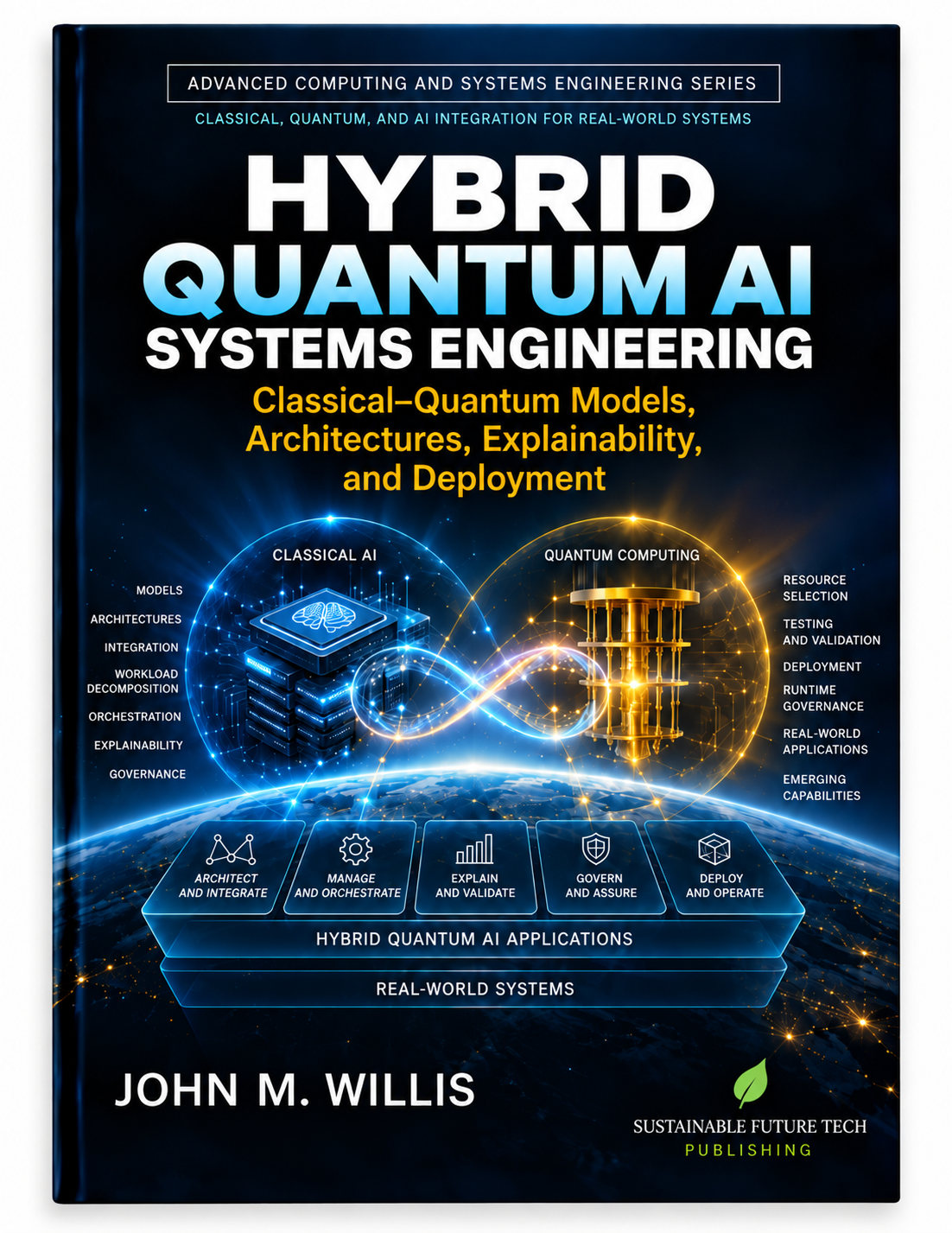
Hybrid Quantum AI Systems Engineering: Classical–Quantum Models, Architectures, Explainability, Runtime Governance, and Deployment
Hybrid Quantum AI Systems Engineering
Classical–Quantum Models, Architectures, Explainability, Runtime Governance, and Deployment
By John M. Willis | First Edition | 2026
Quantum Computing Is Becoming an Engineering Discipline. You Don't Have to Become a Quantum Physicist to Participate.
Quantum computing introduces new computational possibilities—but turning those possibilities into dependable enterprise capabilities requires more than quantum algorithms. It requires systems engineering.
Hybrid Quantum AI Systems Engineering provides a comprehensive, practical foundation for software engineers, architects, AI practitioners, and technology leaders who want to understand, evaluate, design, implement, and govern systems that combine classical and quantum computing.
Rather than treating quantum computing as an isolated specialty, this book approaches quantum processors as components within heterogeneous computing architectures alongside CPUs, GPUs, high-performance computing resources, classical machine learning, data services, and enterprise infrastructure.
The central question is not simply whether quantum computing works. It is whether, where, and how quantum capabilities can deliver measurable value within real systems.
What You'll Learn
Across 27 chapters organized into six parts, the book develops the knowledge and engineering methods needed to:
- Understand quantum computing at implementation depth: Learn the mathematics, qubits, gates, circuits, measurement, encoding, noise, and hardware constraints necessary for sound engineering decisions.
- Implement hybrid quantum AI models: Explore parameterized quantum circuits, variational algorithms (VQE and QAOA), quantum kernels, quantum neural networks, quantum annealing, QUBO optimization, and advanced hybrid models.
- Architect classical–quantum systems: Decompose workloads, establish computational boundaries, select heterogeneous resources, design orchestration flows, and integrate quantum capabilities into enterprise applications.
- Evaluate practical quantum utility: Establish credible classical baselines, design reproducible experiments, measure end-to-end performance, assess resource costs, and distinguish demonstrated value from speculative advantage.
- Engineer for operational reliability: Address portability, deployment, testing, observability, failure handling, reproducibility, and lifecycle management.
- Establish explainability and runtime governance: Preserve provenance, interpret probabilistic results, enforce governance boundaries, and maintain human oversight and organizational accountability.
- Make defensible architecture decisions: Apply feasibility assessments, engineering checklists, evidence classifications, and structured decision methods to determine when quantum capabilities merit adoption—and when they do not.
Beyond Algorithms: From Experimentation to Enterprise Capability
Many quantum computing resources emphasize algorithms, theoretical advantage, or vendor-specific programming environments.
This book addresses a different challenge: How do you turn a promising quantum component into a dependable, measurable, governed capability within an enterprise architecture?
That requires understanding not only quantum computation, but also classical–quantum partitioning, data movement, latency, orchestration, resource constraints, security, reproducibility, explainability, and the evidence required to justify deployment.
The book emphasizes durable engineering principles over rapidly changing SDKs, hardware platforms, and cloud interfaces.
It also makes an important distinction: a negative quantum experiment can be a successful engineering outcome when rigorous evaluation demonstrates that a classical solution remains superior.
Designed for Engineers and Architects
This book is intended for:
- Enterprise software developers expanding into quantum-enabled computing
- AI and machine-learning engineers exploring quantum-enhanced models
- Software, solution, systems, and infrastructure architects
- Quantum developers seeking stronger enterprise integration skills
- Technical leaders evaluating quantum computing investments
- Security, governance, and assurance professionals
- Advanced students and researchers preparing for practical hybrid-system development
Readers do not need to be quantum physicists, although a working knowledge of software engineering, computing systems, and foundational mathematics is helpful.
A Comprehensive Engineering Reference
The first edition includes:
- 27 chapters across six major parts
- Worked implementation and architecture examples
- Engineering exercises and critical evaluation activities
- Dedicated engineer and architect capstone practicums
- Feasibility assessment and resource-estimation templates
- Architecture review, governance, and classical-baseline checklists
- Reproducibility, observability, provenance, and evidence-classification references
- A mathematical reference, quantum notation guide, glossary, and companion-resource guidance
Build Before the Future Arrives
Organizations do not need to wait for quantum hardware to reach universal maturity before developing the engineering capabilities required to evaluate and integrate it responsibly.
The next generation of hybrid quantum AI systems will require professionals who understand both computational possibilities and operational realities.
Hybrid Quantum AI Systems Engineering provides a foundation for that transition—helping engineers and architects move from quantum experimentation toward evidence-based, production-oriented systems design.
Publication Details
Author: John M. Willis
Publisher: Sustainable Future Tech Publishing
Edition: First Edition (2026)
ISBN: 979-8-9971149-1-6
Format: Digital PDF
Length: 757 PDF pages