
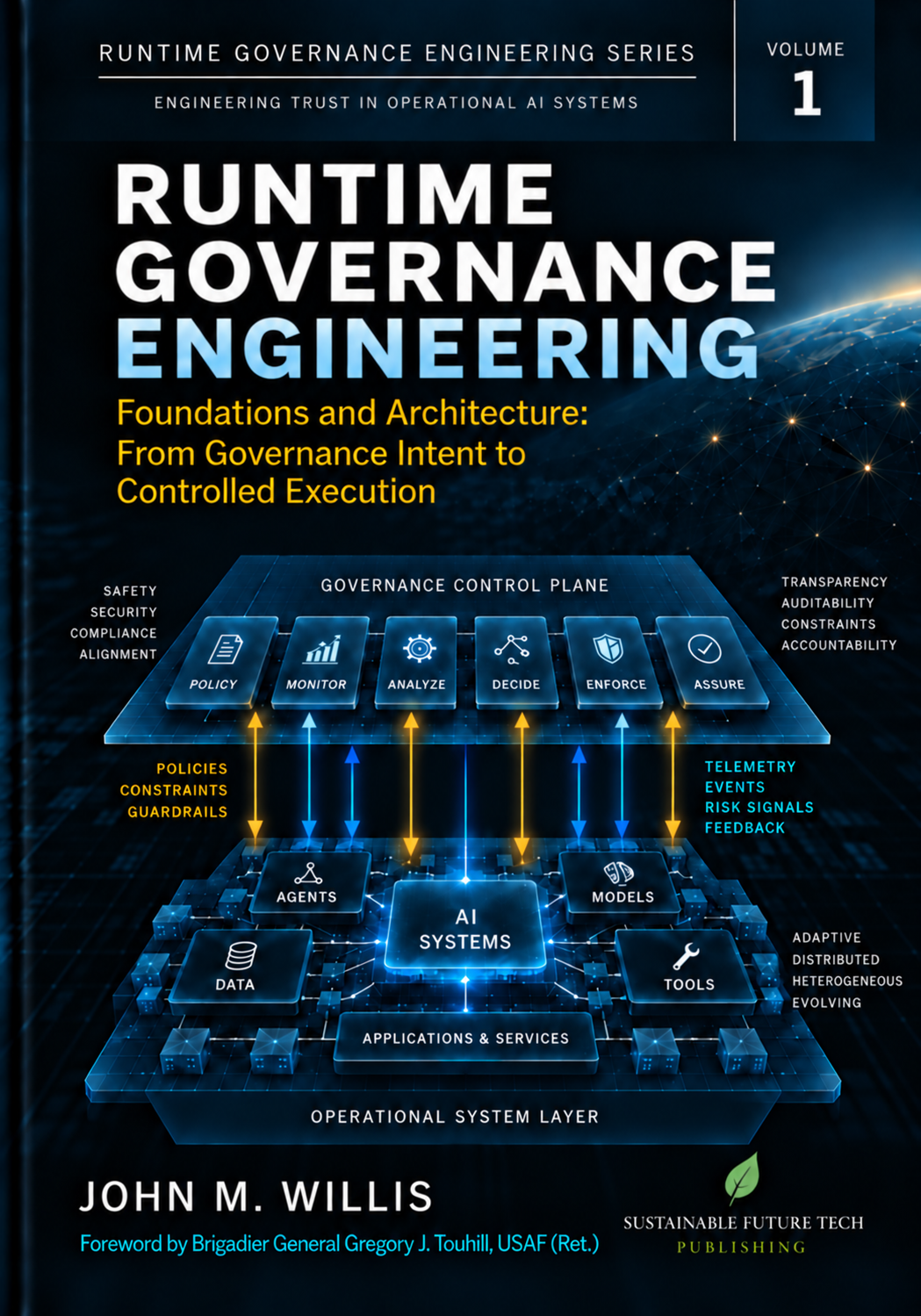
Runtime Governance Engineering: Foundations and Architecture—From Governance Intent to Controlled Execution
Runtime Governance Engineering: Foundations and Architecture—From Governance Intent to Controlled Execution
A comprehensive architectural reference for enterprise AI governance, security, controlled execution, and assurance.
Your organization may have AI governance policies, approval workflows, identity controls, model guardrails, and monitoring in place.
But can it demonstrate that a consequential action proposed by an AI agent will be independently evaluated against current authority, system state, evidence, and governing constraints before that action is allowed to execute?
That is the engineering problem addressed by Runtime Governance Engineering (RGE).
As enterprises deploy AI and autonomous systems that can change permissions, initiate transactions, modify infrastructure, disclose information, and coordinate with other systems, governance must remain effective at the point where proposed actions become operational consequences.
This book establishes Runtime Governance Engineering as a discipline for designing, implementing, evaluating, and assuring that capability.
Why Enterprise AI and Security Leaders Need This Reference
Runtime Governance Engineering, Volume 1 provides the technical foundation for making critical enterprise architecture and investment decisions.
It helps organizations and their technical leaders:
· Evaluate existing AI governance capabilities. Distinguish policies, guardrails, IAM, monitoring, approval workflows, and policy engines from enforceable runtime governance.
· Establish architectural requirements. Determine how consequential actions should be represented, evaluated, authorized, bound to current conditions, and controlled at execution.
· Assess technology and vendor claims. Identify the governance responsibilities, enforcement boundaries, and evidence needed to assess whether a solution supports deterministic runtime control.
· Plan enterprise implementation. Examine how runtime governance can be integrated with existing security, identity, transaction, orchestration, cloud, and governance infrastructure.
· Develop assurance and testing criteria. Understand invariant preservation, non-bypassability, commit-bound revalidation, structural refusal, lifecycle evidence, and replayability.
· Establish an adoption roadmap. Identify consequential workflows, select bounded pilots, establish meaningful exit criteria, and expand governance capabilities across enterprise systems.
The objective is to help organizations make better-informed architecture, implementation, assurance, and investment decisions before placing consequential AI actions into production.
A Worked Enterprise Example
Consider an autonomous identity-provisioning agent that proposes assigning a privileged entitlement.
The agent has a valid workload identity. The proposed entitlement has passed the applicable checks, and a previously valid approval has been recorded.
But before the action is committed, the approving officer's delegated authority is revoked.
Should the entitlement still be granted?
Chapter 25 develops a detailed, illustrative enterprise scenario that traces this problem through governance requirements, compiled governance artifacts, agent proposals, canonical state, authorization, commitment, execution, and evidence.
In its refusal variant, the system prevents the entitlement assignment because the approval authority required for commitment is no longer valid.
The example demonstrates the architectural distinction between a previously approved action and an action that remains authorized and admissible at execution.
What the Book Covers
Across 27 chapters and ten technical appendices, Volume 1 develops:
· Runtime Execution Governance: Governing consequential actions at the boundary between proposal and operational reality.
· Governance Compilation: Translating authorized human governance requirements into controlled, machine-evaluable artifacts.
· Runtime Governance Architecture (RGA): A general architectural model for governance evaluation, commitment, enforcement, and evidence.
· The AI Governance Control Plane (AGCP): A reference realization illustrating deterministic governance and controlled execution.
· Formal execution semantics: State transitions, authorization, admissibility, governing invariants, non-bypassability, and commitment consistency.
· Enterprise integration: Relationships with IAM, Zero Trust, policy engines, workflows, transaction systems, monitoring, and existing control infrastructure.
· Multi-agent governance: Maintaining authority, context, evidence, and accountability across coordinated autonomous systems.
· Implementation and assurance: Architecture patterns, failure modes, operational integration, pilot selection, adoption maturity, testing, and evidence-based assessment.
Who Should Read This Book?
This professional reference is intended for enterprise architects, AI governance architects, AI security architects, systems engineers, assurance practitioners, and technical leaders responsible for trustworthy autonomous systems.
It is also relevant to CIOs, CISOs, CTOs, Chief AI Officers, governance leaders, and technology decision-makers working with technical teams to establish enterprise AI control requirements, evaluate architectures, assess risk exposure, and plan implementation.
The central question is:
May this proposed consequence become operationally real now—and what engineering evidence establishes that the answer is justified?
RGE develops an architectural framework for answering that question with explicit authority, current evidence, deterministic controls, and enforceable commitment boundaries.
About This Edition
Foreword by Brigadier General Gregory J. Touhill, USAF (Ret.), CISSP, CISM, NACD.DC.
Digital PDF Edition
7 × 10 inch professional reference format
27 chapters, ten technical appendices, references, and index
ISBN: 979-8-9971149-0-9
Published by Sustainable Future Tech Publishing
Preview the book before purchasing.
The preview available above provides an opportunity to review the book's structure, introductory material, and opening chapter before deciding whether it meets your professional or organizational needs.